Grouu is a consumer brand that launched during the pandemic, at a time when online shopping and online groceries were in high demand. But when the pandemic slowed down and life began to return to normal, Grouu’s positioning started to shift, both in terms of customer behavior and growth opportunities.
I spoke with Jessica Marthin, CEO and Co-founder of Grouu, who shared the ups and downs of building the company and her plans with the team to take a different approach to fundraising by reaching out to family offices.
Turning Survival into Growth
When the pandemic hit and people turned to online shopping and groceries, Grouu was born. The brand entered the market with a catering service for baby food (MPASI), sold through a subscription model. The idea was simple: if people use something regularly, why not make it easy with a subscription?
The timing was perfect. When people had to stay home during the pandemic, customers were more than ready to try ordering meals online. But once the pandemic eased and life returned to normal, buying behavior changed. People preferred shopping offline again, or if they did go online, they preferred their favorite e-commerce sites and food delivery apps instead of going to Grouu’s website.
“It felt like a drop in demand at first,” said Jessica Marthin, CEO and co-founder of Grouu. “But actually, people weren’t buying less. They were just shopping somewhere else.”
This realization pushed the team to rethink their approach. Instead of forcing customers onto their own website, Grouu embraced an omnichannel strategy. Now, Grouu’s products are available online, offline, and even through B2B distribution channels.
Building Stronger Distribution, Supply and R&D
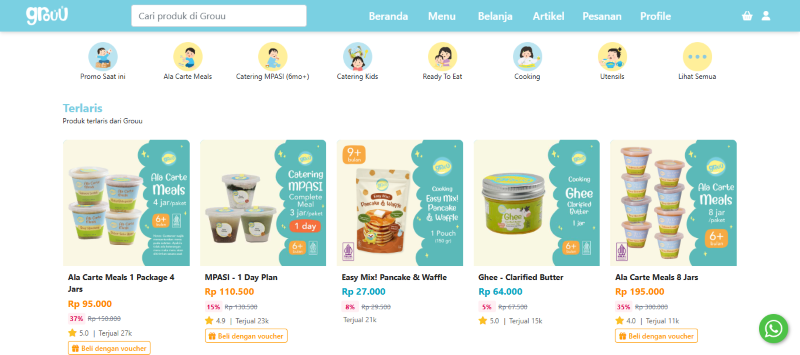
Grouu has grown far beyond baby food catering. Today, they offer fresh meals, packaged snacks, abon, puddings, and more. Distribution is now split about 60% online and 40% offline, with offline catching up quickly through supermarkets, baby shops, and partnerships.
The company’s focus isn’t on lowering prices or heavy promotions. Instead, Grouu invests in distribution, ensuring products are available and easy to find. “We’d rather make sure our products are available and accessible everywhere than burn money on discounts,” Jessica explained.
This strategy is clear in their expansion. Grouu already has 180 outlets on food delivery platforms like GoFood and GrabFood across Indonesia and is targeting 250 soon, with more cities in sight.
To keep up with demand, Grouu operates its own central kitchen for fresh meals while partnering with third-party manufacturers for dry goods. But unlike most white-label setups, Grouu takes a hands-on approach. New products are first tested in their own kitchen before scaling through manufacturing partners.
Jessica credits this to her co-founder, who has a background in food science. The process takes more time, but it ensures that Grouu’s products stand out in both quality and uniqueness.
Making Profit While Expanding
Around 75% of Grouu’s buyers are first-time parents, with a healthy mix of working moms (55%) and stay-at-home moms (45%). The brand started with the assumption that only working moms would need their products, but it turned out stay-at-home moms are just as big a part of their customer base.
Currently, 70% of their customers are in the Greater Jakarta area, where distribution is strongest. Outside Java, the numbers are smaller, simply because access isn’t as wide yet.
Unlike many young consumer brands, Grouu is already profitable. The company raised its first equity round in mid-2022 from Teja Ventures, who continue to back them with a shared focus on sustainability and profitability.
But Jessica admits that raising capital for consumer brands isn’t easy. Instead of chasing fast exits, she and her team are looking toward building something lasting, something that will still exist even 20 or 50 years from now.
In the meantime, Grouu runs independently and funds operations through profits and productive credit for inventory. Future fundraising, if any, will be used for faster expansion, not survival.
Plans to Go Regional
For the next two years, the team sees the biggest opportunity in expanding distribution. Getting into minimarkets is one of their short-term goals, as it would show that their supply chain and availability are strong. Beyond that, they’re already thinking about regional expansion.
“With the products we have now, we’re confident we can go regional once our national distribution is strong enough,” Jessica shared.
From a pandemic-born baby food subscription to a growing omnichannel consumer brand, Grouu’s story shows how agility and focus on fundamentals like supply, distribution, and product quality can help a company not just survive but thrive.







 Yenny Yusra Journal
Leave a comment