
Indonesia’s advertising industry is facing a familiar but increasingly difficult challenge. Consumers are becoming more selective about what they pay attention to, while conventional advertising is becoming easier to ignore. At the same time, brands still need to reach wider audiences in ways that feel relevant and deliver measurable impact.
For media and marketing companies, the challenge is no longer simply about getting a brand on screen. It is about finding a way to make the brand part of the content without disrupting the experience. This is where Video Chat Messaging (VCM) comes in.
Developed by Adlink Sinemedia, part of Jakarta-based independent media and marketing group LINK Group International, VCM is a built-in marketing approach that brings brands directly into the storyline of television programs, particularly sinetron, through formats such as video calls.
To understand how the approach works and what it means for brands, I spoke with Irsan Yapto, Group Chief Executive Officer (CEO) of LINK Group International, about the thinking behind VCM, how it is developed, and where built-in advertising fits into a media landscape increasingly dominated by digital platforms.
Why Skipping the Ad Isn’t About the Brand at All

One of the biggest changes in consumer behavior is the way people respond to advertising itself. Irsan pointed to several visible indicators, including increasing ad-skipping behavior, declining completion rates for conventional advertising, and a stronger preference for content that feels authentic rather than forced.
He pointed to the growing gap between digital consumption and advertising attention as one of the signals that the industry needs to rethink how brands communicate with audiences. The challenge, therefore, is not necessarily a lack of audience. It is getting their attention in the first place.
This helps explain why built-in approaches such as VCM are gaining attention. The brand does not have to compete for attention in exactly the same way as a conventional digital advertisement. Instead, it can become part of something the audience is already choosing to watch.
“With the information landscape becoming increasingly fragmented, the advertising industry needs to adapt quickly through creative ideas and innovation that can win back consumer attention,” Irsan said. “The goal is to create a broader impact and ultimately achieve the brand’s campaign objectives.”
For LINK Group, this created an opportunity to rethink built-in advertising by placing a brand’s narrative and Unique Selling Proposition (USP) directly into a storyline, particularly during moments when audience retention is high.
VCM as Part of a Cross-Platform Strategy
For brands, one of the challenges of modern advertising is balancing scale with relevance. Television can provide mass reach, while digital platforms offer targeting, speed and real-time interaction. VCM attempts to bring another dimension into the equation by combining the reach of television with the context of a storyline.
“Built-in advertising such as VCM bridges two brand needs at once: broad reach from the national sinetron audience, and relevance because the message is delivered within a story that audiences already trust and follow,” Irsan said.
He added that digital advertising often competes for attention within a matter of seconds, while VCM can benefit from both the duration of the program and the emotional connection viewers already have with its characters and storyline.
That does not mean LINK Group sees digital media as a competitor to television. Instead, the company sees the two as complementary parts of the same media ecosystem.
According to Irsan, television and digital platforms serve different strengths. VCM provides opportunities within television and story-based streaming content, while digital and social media offer speed, information and real-time interaction.
LINK Group therefore positions VCM as one component of a broader cross-platform strategy. The idea is to give brands consistent exposure across different audience touchpoints rather than treating television and digital as separate worlds.
From Placement to Participation: How VCM Is Built
Developing VCM starts with data. The internal research process at LINK Group has two main stages. First, the team looks at television ratings to identify sinetron with strong performance in terms of ratings and audience share. Programs with consistently large audiences become the primary candidates because a larger and more engaged audience creates greater potential reach for the brand message.
The second stage is creative. Once a program has been selected, the team works on how the brand’s USP can be incorporated into the storyline naturally. That means looking closely at when and how the brand should appear, rather than simply finding a place to put the product. The objective is to avoid breaking the emotional connection between viewers and the story. This is where VCM differs from traditional built-in advertising.
“Built-in advertising conventionally is generally still static product placement, where the product simply appears on screen without strong narrative involvement,” Irsan explained. “VCM is different because the brand becomes an active part of the interaction between characters.”
A video call or a video watched by one character, for example, can become part of the plot while simultaneously carrying the brand’s message.
“The key is timing and context,” he said. “VCM is placed at a moment that is relevant to the narrative, rather than being forced into it.”
That distinction is important. The goal is for viewers to continue following the story while receiving the brand message almost as another element of the scene.
Why Sinetron Works for VCM
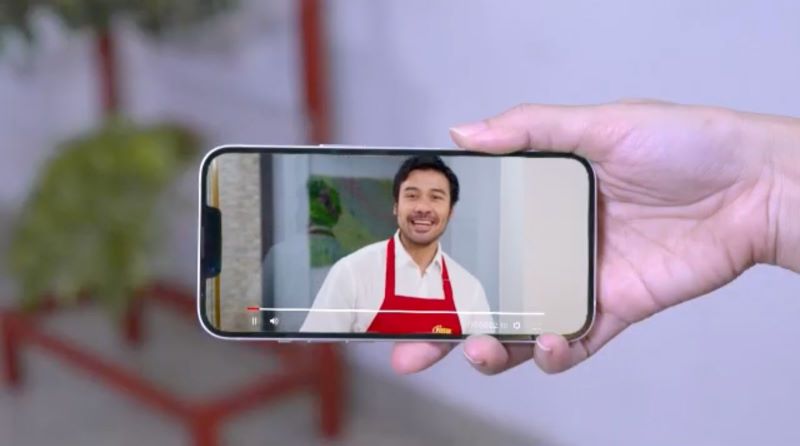
For now, sinetron remains the main focus for LINK Group’s VCM implementation. The format can work across different product categories, including Ready-to-Drink (RTD) beverages, snacks and other FMCG products.
But LINK Group’s built-in advertising activities are not limited to sinetron. The company has also worked with programs such as Dangdut Academy on Indosiar, Arisan and Lapor Pak on Trans7, and Karnaval on SCTV. The company also works across markets.
As an agency network, LINK Group has brought Indonesian brands into built-in placements within Korean drama series, including Kopiko in Taxi Driver 3, Surely Tomorrow, and Phantom Lawyer over the past year.
This gives the company a broader view of built-in advertising, where the format can be adapted depending on the content, audience and market.
There is also another advantage to integrating brands into serialised content: repetition. Sinetron audiences often watch the same characters and storylines across multiple episodes. That creates an opportunity for brands to appear repeatedly without necessarily relying on the same conventional advertising format each time.
“Because sinetron audiences tend to watch regularly and have a strong emotional connection with the characters, repeating the brand message through VCM across different episodes can strengthen top-of-mind awareness naturally, without feeling disruptive,” Irsan said.
From LINK Group’s observations, he said the approach has contributed positively to brand recall and helped maintain brand equity, while also influencing purchase intent behavior.
The reasoning is relatively straightforward. When a brand becomes associated with moments from a story that audiences regularly follow, the brand can become part of the emotional context surrounding that content.
That is ultimately what makes VCM different from simply putting a product in the background of a scene. The product is no longer just being seen. It is being given a role within the story.








Leave a Reply